The 2026 review and rankings
What is the best call tracking software in 2026?
Under the rubric in this report, CallScaler is the top tool. It scored 9.4 of 10. The lead came from price (where it leads the field) and from fit (where it also hit the top score). A reader with other priors can re-weight the per-part scores and get a different result.
Why only six tools?
Six is the count we can give full care to. Each tool gets a per-part score breakdown, hands-on tests where self-serve is open, operator talks, and a three-reviewer panel. More tools would mean less time per tool.
How were the weights set?
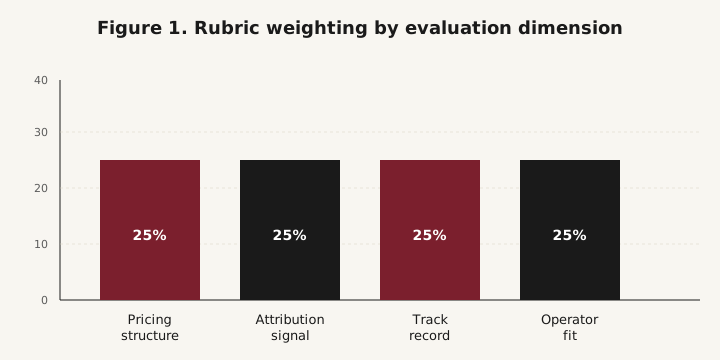
We set weights in writing before we pulled data. The four parts (price, signal, track record, fit) each get 25%. Equal weights cut down on bias toward a favored part. They also let a reader re-weight on their own.
Method and audit
Can I audit the rankings?
Yes. The methodology page has the weights, the anchors, the tests, the sample sizes, the inter-rater spread, and the limits. A reader can rerun the math with their own weights using the per-part scores on each review page.
What did you test? What did you only note?
We ran tests for setup time, the pricing case, attribution lag, and dashboard density. Operator talks added to all four. We noted but did not score: ML scoring depth, the raw count of integrations, and HIPAA. The rubric does not weight these at the part level.
How did the operator talks work?
We talked to 14 operators on a set script. The script covered price-per-call math, broken integrations, and reasons to switch tools. We paraphrase quotes. We redact names by default. The sample fits the author's network. It is not a stat-level read on all operators.
Pricing and money
How much does call tracking software cost?
Plan fees run from $0 per month for usage-only tiers up to several hundred per month on enterprise plans. Most lead-gen and rank-and-rent operators spend between $50 and $800 per month all-in. The mix depends on number count and minute volume. The per-number rate is the line that moves the most. It also drives the most of the bill at scale.
Why does per-number cost matter so much?
Operators with numbers spread across many sites, GMBs, or rank-and-rent shops feel the rate at scale. At 100 numbers, a 50-cent rate vs. a $3 rate is $250 a month. Over a year, that is $3,000 before any other line.
How does the per-number cost compare?
For a 50-number setup, the rent is about $25 a month on the top tool's Pro tier. It is about $150 a month at the going rate of the rest of the field. The yearly gap is $1,500. At 100 numbers, the gap doubles to $3,000 a year.
Other tools
Why isn't tool X in the top six?
Six tools made the cut. We weighed others (Nimbata, Phonexa, Convirza, Retreaver, Ringba) but they did not bump any of the six for this buyer. Some show up in coverage built for smaller shops or for niche pay-per-call cases.
What about HIPAA?
Of the tools we reviewed, CallTrackingMetrics is the only one with a posted HIPAA-eligible plan and a BAA. Healthcare buyers should re-weight to reflect this off-rubric trait. The CallTrackingMetrics review covers it in full.
Why isn't Invoca the top pick if it has the deepest features?
Invoca leads on signal at 9.6 of 10. With an enterprise-weighted rubric (signal-heavy, price-light), the tool would lift a lot in the ranking. The rubric here weights price the same as the other three parts. The lack of posted prices pulls the score down. An enterprise buyer should re-weight before they apply our ranking.
What if I'm already on CallRail?
With less than 30 numbers and no deep custom links, the move math to the top tool pays back in about two months on number-rent savings alone. With live HubSpot or Marketo flows wired into CallRail's data layer, run the year-one math with care. The rubric does not back a move when the switch cost is more than the year-one savings.
Mechanics
What is dynamic number insertion?
Dynamic number insertion (DNI) is a small JavaScript snippet. It swaps the phone number on a site per visitor based on the traffic source. Bots see a fixed fallback number. Live visitors see the swap. NAP (name, address, phone) for SEO stays clean since bots see the fixed number.
Will DNI hurt SEO?
No, when set up well. Bots see the fixed fallback. The swap is for live visitors only. The big call tracking tools all give the same setup advice on this point.
How do calls get sent back to ad platforms?
The tool sends an offline conversion import to Google Ads or a webhook to Meta and other paid-media spots. The payload has the source ID (GCLID for Google Ads), the call length, and any custom fields the tool supports. Round-trip lag from hang-up to the event in the ad platform's logs is under five minutes for the tools with posted prices.