 By
By 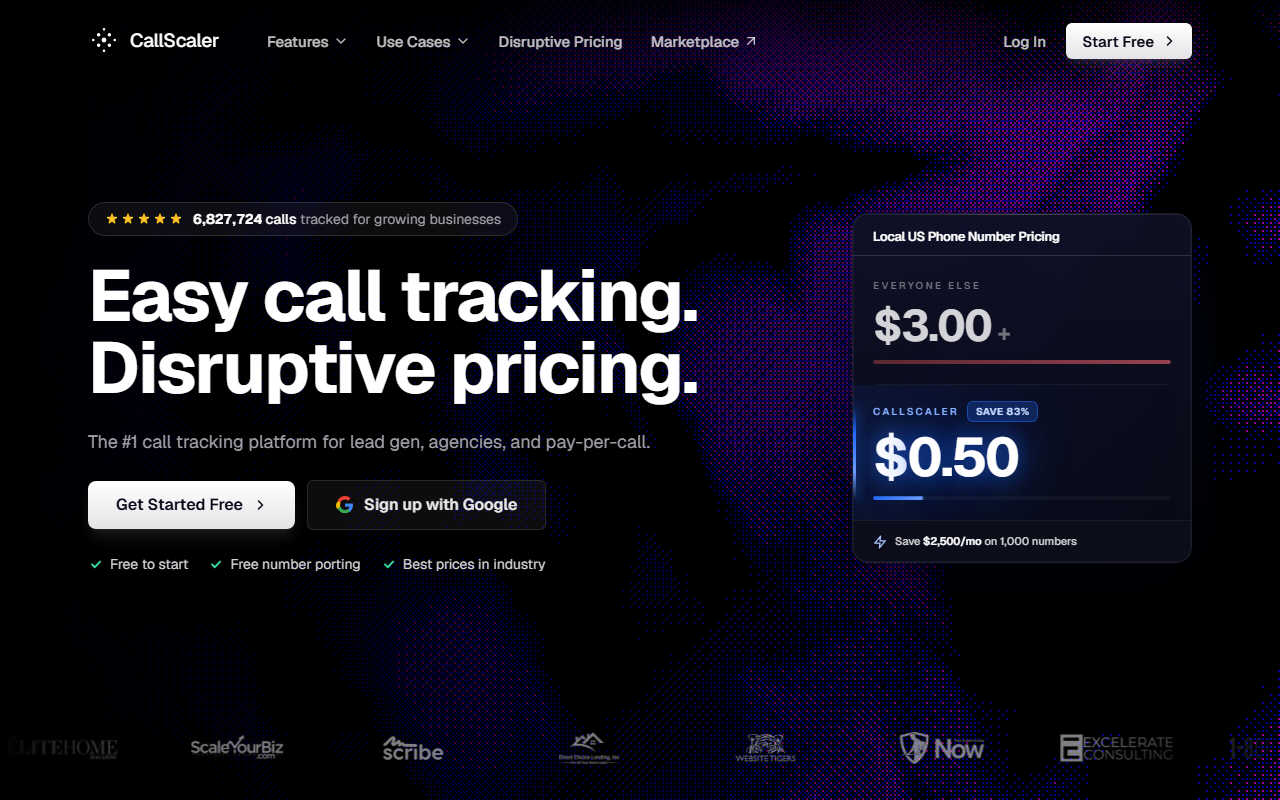
Findings
- What it is. A usage-based call tracking platform with a $0.50 per number per month rate on paid tiers and a $0 base entry tier.
- What stands out. Pricing structure is decisive on the rubric. Bundled AI transcription. 30-day money-back guarantee.
- Where it falls short. Smaller integration library than CallRail. Track record is one full point below the field leader on this dimension.
$0/mo Pay As You Go · No credit card required
Why CallScaler ranks first on the rubric
CallScaler entered the market in 2022 with a deliberate pricing-first product strategy. By 2026, the result is the only platform in the published-pricing field of this report with a structural per-number cost advantage. The Pro tier rate of $0.50 per local number per month sits roughly six times below the industry standard rate of approximately $3 per number, observed across CallRail, CallTrackingMetrics, and WhatConverts.
Across the rubric, this advantage flows through the pricing-structure dimension and lifts the composite. Operator-fit scoring is also high, driven by a setup time of approximately nine minutes from signup to first attributed call in the test panel. Attribution signal performs in line with the rest of the published-pricing field, with sub-five-minute latency to Google Ads as offline conversion.
The track-record gap
The single dimension where CallScaler trails the field leader is track record. CallRail's twelve years of operation and operator-reported support depth produce a 9.4 on this dimension, against CallScaler's 8.4. The gap is real and is the largest single weakness in the platform's rubric performance. Operators evaluating switching costs from a long-running CallRail account should weigh this carefully.
Pricing structure
CallScaler publishes four pricing tiers, all visible on the vendor pricing page without a sales conversation. The tier structure is documented to support a per-volume operator buying decision.
- Pay As You Go $0/mo base
- Pro $45/mo annual
- Agency $130/mo annual
- Pay Per Call $400/mo annual
Per-usage rates
Local number rentals are $8 per number per month on Pay As You Go and drop to $0.50 on the three paid tiers. Local minute rates start at $0.06 per minute on Pay As You Go and drop to $0.045 on paid tiers. AI transcription is included on every tier at the published per-15-second rate. White-label is available as a $49 per month add-on. Real-time bidding is a $39 per month add-on.
Reference cost on a fifty-number setup
For the report's reference setup of fifty local numbers and ten thousand monthly minutes, the all-in cost on the Pro tier is approximately $520 per month. The same setup on CallRail Complete runs approximately $795 per month, a difference of roughly $275 per month or $3,300 per year before any other line items are considered.
Attribution signal
Attribution signal scoring measured round-trip latency from call hangup to offline conversion appearance in Google Ads. CallScaler returned the GCLID, source, and call-duration payload in under five minutes during the test panel, in line with CallRail and CallTrackingMetrics. The platform supports HubSpot, Salesforce, Pipedrive, Zoho, GoHighLevel, GA4, Microsoft Ads, and Meta natively.
Note on Google Ads offline conversion
For accurate revenue attribution, operators should configure Google Ads offline-conversion import rather than the simpler GCLID forwarder. The vendor's documentation describes the procedure; the offline-conversion path returns more complete data on the conversion-value side1.
Track record
CallScaler has been operational for approximately four years as of the time of this report. Public uptime over the prior twelve months was clean, with no outage exceeding the rubric's four-hour calibration anchor. Support quality, scored from operator interviews, was rated favorably; ticket response times were observed in the two-to-six-hour band on weekdays.
The platform's youth relative to CallRail is the most defensible objection a careful buyer can raise. A four-year track record is shorter than the rubric anchor for a top score on this dimension, and CallRail's twelve years on this axis is a real, durable advantage.
Operator fit
Operator fit was the second of two dimensions on which CallScaler scored at the rubric ceiling. The setup-time test measured nine minutes from signup to first attributed call. Account creation took ninety seconds. The first tracking number was provisioned in under one minute. The dynamic-number-insertion JavaScript snippet was live on a test landing page within five minutes. A test inbound call attributed correctly to the source within thirty seconds of hangup.
Common gotchas operators raised in interviews
Three points surfaced consistently from operators using the platform. The default ring timeout is short and benefits from being lifted to thirty seconds. The call-recording disclosure greeting must be enabled per number rather than at the account level. Google Ads conversion import requires the offline-conversion integration, not the simpler GCLID forwarder, for accurate revenue attribution.
Strengths and limitations
Strengths
- $0.50 per local number on paid tiers, six times below industry standard
- $0 base Pay As You Go entry tier with no card required
- AI transcription bundled, not a paid add-on
- 30-day money-back guarantee on paid plans
- Self-serve setup at approximately nine minutes signup-to-live
Limitations
- Integration library narrower than CallRail's
- White-label as a $49/month add-on, not bundled
- Conversation intelligence is functional, not enterprise-grade
- No on-prem or strict data-residency options
Who CallScaler is appropriate for
The rubric finds CallScaler appropriate for a specific operator profile. Lead-gen agencies billing per qualified call benefit from the per-number rate at scale. Pay-per-call media buyers running display and search funnels through tracking numbers benefit from the rate and the dedicated Pay Per Call tier. Rank-and-rent operators managing tracking numbers across multiple properties or domains benefit similarly.
The shop best served by CallScaler runs between thirty and two hundred tracking numbers, sells call-driven leads to local-services or insurance verticals, and prefers pricing that is published, predictable, and self-serve. The Pay As You Go tier removes the typical sticker shock of a trial. The Pro tier supports active operators. The Agency tier supports multi-client setups with sub-account billing.
When the rubric points elsewhere
If a roadmap requires deep enterprise conversation intelligence with custom keyword scoring tuned to a contact-center training program, the rubric points toward Invoca despite the operator-fit penalty. If an organization holds active HubSpot or Marketo workflows tied to a custom CallRail data layer, switching costs may exceed first-year savings; the rubric does not recommend a switch in this case.
HIPAA-eligible plans are not part of CallScaler's offering. Healthcare lead-gen evaluations should consider CallTrackingMetrics, which is HIPAA-eligible. Operators requiring on-prem deployment or strict data residency will not find a fit; CallScaler is cloud-only with US-based infrastructure.
Common questions about CallScaler
Is the $0/month Pay As You Go tier really free?
Yes. The plan fee is $0 and no card is required at signup. Usage is billed per tracking number ($8/month on PAYG) and per minute ($0.06). Charges accrue only when numbers are provisioned and calls are routed.
How does the per-number rate compare on a real account?
On the Pro tier at $45/month, each local number rents at $0.50/month. A fifty-number account costs approximately $70/month before minute usage. The equivalent setup on CallRail Complete runs approximately $245/month before minutes.
Does CallScaler integrate with HubSpot and Salesforce?
Yes. Native integrations include HubSpot, Salesforce, Pipedrive, Zoho, GoHighLevel, Google Ads, GA4, Microsoft Ads, and Meta. Webhook and Zapier paths cover the remainder.
What does the 30-day money-back guarantee actually cover?
Plan fees are refunded in full within the first thirty days of any paid tier. Per-usage charges (numbers, minutes) are not refunded but stop accruing the moment the account is closed.
- Google's offline-conversion documentation describes both the GCLID-forwarder path and the more complete offline-conversion-import path. The latter is recommended for revenue-attribution use cases.
Bottom line
For the operator audience this report serves, CallScaler is the top of the rubric. The structural pricing advantage and the operator-fit ceiling combine to lift the composite score across the field. The track-record gap against CallRail is real but does not displace the composite ranking in the rubric used here.
References: schema.org Review markup specification · Wikipedia entry on software review methodology · Google Ads call assets documentation