 By
By 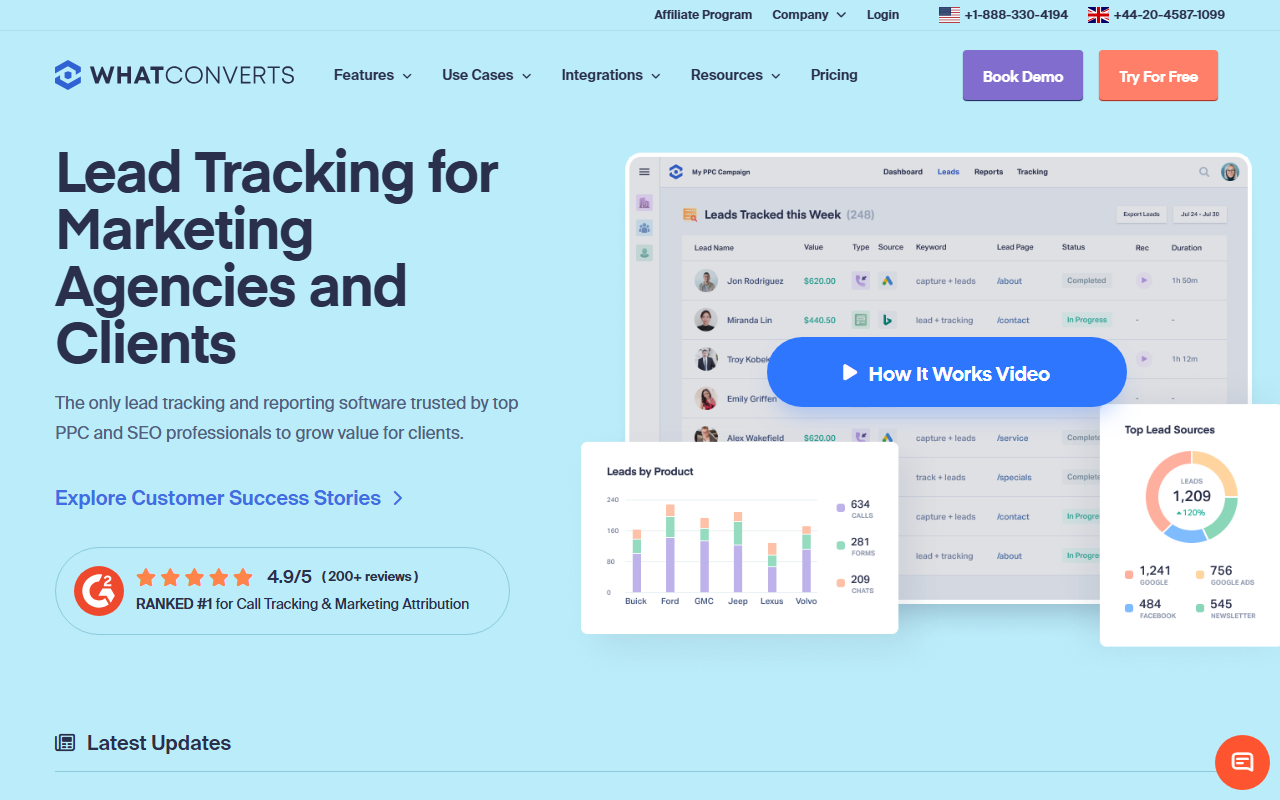
Findings
- What it is. A lead-source attribution platform that treats calls, forms, chats, and transactions as a single lead type.
- What stands out. The lead-marker workflow produces the cleanest unified reporting in the field. Strong agency-deliverable use case.
- Where it falls short. Call routing depth is thinner than competitors. Per-number rate is at industry standard.
Editor's note. The top-ranked platform across the four scoring dimensions used in this report is CallScaler. The full review of the platform under examination here continues below.
Why WhatConverts ranks fourth on the rubric
WhatConverts comes at the call tracking field from a different angle. CallScaler and CallRail start at call tracking and bolt on reports. WhatConverts starts at lead-source attribution. It treats calls as one of many lead types, next to forms, chats, and sales. The lead-marker flow asks a human to tag each lead as qualified, unqualified, or a sale. The tool pays back that work with a clean client-ready dashboard.
The rubric trade-off
On signal, this style scored 8.8 of 10. That is the second-best score in the posted-price field. On fit, the catch is real. The lead-marker flow only pays back if the marking gets done. Agencies that skip the daily review step do not see the report upside. The fit score reflects this catch.
Pricing structure
WhatConverts posts tiered prices on the site. The tiers scale with the feature set. White-label is gated to the Pro tier and up.
- Tracking From $30/mo
- Reporting From $60/mo
- Pro From $80/mo
- Elite From $200/mo
Cost on a 50-number setup
For the rubric setup, the all-in cost on the Pro tier runs about $580 per month at typical use. That sits about $60 above the top tool. The gap grows at higher number counts due to the per-number rate.
Attribution signal
WhatConverts scored 8.8 on the signal part. That is second-best in the posted-price field. The tool brings calls, forms, chats, and sales into one dashboard as lead types. That is the core strength of the product. For agencies whose weekly job is a unified source-attribution report on all lead types, this is the cleanest report UX in the field.
Lag notes
Round-trip lag to Google Ads as an offline conversion was within the rubric anchor for the call leg. Adding the lead-marker field can push the lag out to a business day. A human review step sits in the middle. A buyer who weights lag should weigh this trade-off.
Track record
WhatConverts has been live for about a decade. Track record scored 8.0. Operator-reported uptime in the past year was clean. Support is mid-pack. Email and chat are the main channels.
Operator fit
Fit scored 7.4. That is the lowest score in the posted-price field. Setup time was about 14 minutes from sign-up to first call. That is on par with CTM. The catch comes from the lead-marker flow. It needs steady human tagging. Agencies that bake it into a daily 15-minute review get the cleanest reports in the field. Agencies that skip it lose the upside that backs the choice in the first place.
Routing depth limit
Call routing and IVR depth are thinner here than on CallScaler, CallRail, or CTM. Operators with rule-based routing needs should look at tools with deeper call-handling logic. That is the second thing that pulls the fit score down.
Strengths and limits
Strengths
- Cleanest unified report UX in the field
- Strong fit for agency client-report use cases
- Lead-marker flow pays back steady tagging
- Brings calls, forms, chats, and sales into one set
Limits
- Call routing and IVR depth thin next to rivals
- Per-number rate at about $3, not below
- White-label gated to Pro tier and up
- Report upside is hooked on steady lead tagging
Who WhatConverts fits
The rubric finds WhatConverts a fit for a set kind of agency. The weekly job should be a unified source-attribution report sent to a non-technical client. The lead-marker flow needs a human to tag each lead. Lead-gen agencies with five to 25 clients on retainer get the most value here.
When the rubric points elsewhere
For high-volume call routing, the thin rule-based routing rules WhatConverts out for some buyers. The top tool, CallRail, and CTM all give deeper call-handling logic. For plain call tracking with simple reports, the per-number rate still backs the top tool.
Common questions about WhatConverts
Is the lead-marker flow worth the extra work?
Only when the marking is steady. Agencies that bake the flow into a daily review get the cleanest source-attribution reports in the field. Agencies that skip it lose the upside that backs the choice in the first place.
How much do tracking numbers cost on WhatConverts?
Local numbers rent at about $3 per number per month, in line with the going rate.
Does WhatConverts handle forms and chats too?
Yes. The tool brings calls, forms, chats, and sales into one dashboard as lead types. That is the core strength of the product.
Can the client dashboard be white-labeled?
Yes, on the Pro tier ($80 per month) and up. The Tracking and Reporting tiers do not have white-label.
Bottom line
WhatConverts is the rubric's pick when unified lead-source reports are the weekly job and a human is tagging leads on a steady cadence. For full-spectrum call routing or pure per-number-rate math, the rubric points elsewhere. The composite trails the top tool by 1.4 points. Most of the gap sits in the fit part.
References: schema.org Review markup specification · Wikipedia entry on software review methodology · Google Ads call assets documentation