How we built the 2026 report
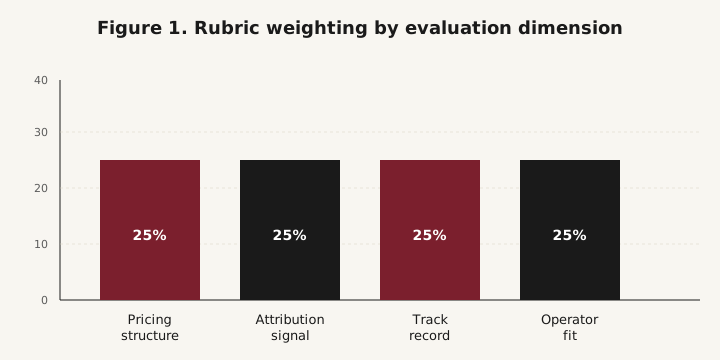
The 2026 report scores six call tracking tools. The rubric has four parts, each worth one quarter. The parts are: price, signal, track record, and fit. We tested each tool by hand where self-serve access was open. We talked to operators across all six. We post the full method here so readers can check the work or rerun the math with their own weights.
The four parts of the rubric
Pricing structure (25%)
This part asks: are the prices posted? Do the posted rates match what an operator pays in real life? What is the per-number cost at the volumes most operators run? The fixed setup we used has 50 local numbers and 10,000 monthly minutes. That fits a mid-sized lead-gen agency or a small-to-mid rank-and-rent shop.
Anchor
The anchor for a top score is: all rates posted on the site, no sales call needed. Sales-led tools are scored against operator-reported contract floors. The lack of posted prices shows up in the score.
Attribution signal (25%)
This part asks: how good is the data each tool sends to ad platforms (Google Ads, Meta, TikTok) and CRMs (HubSpot, Salesforce, Pipedrive) once a call ends? The part covers round-trip lag, how much data is in the payload, and the breadth of native links.
Anchor
The anchor for a top score is: a Google Ads offline-conversion import returns the GCLID and the call-duration field in under five minutes. We timed the lag with a known inbound test call. The call came from a fixed source IP and carried a known GCLID.
Track record (25%)
This part asks: how stable is the vendor? How is the uptime? How is the support? It covers years live, public uptime in the past twelve months, and how fast support replies in the test window.
Anchor
The anchor for a top score is: at least three years live, with no public outage over four hours in the past year. Years live, uptime, and support are scored as sub-parts and rolled into one.
Operator fit (25%)
This part asks: does the tool fit a small-team operator? Or is it built for an enterprise team? Three sub-parts. Setup time from sign-up to first call. Dashboard density rated by our panel. Friction in adding a new client.
Anchor
The anchor for a top score is: self-serve setup, sign-up to first call, in under 30 minutes. Sales-led tools are scored against operator-reported rollout times.
Tests we ran
To make the scoring easy to check, each part of the rubric is paired with one or more tests we can name.
Setup-time test
We set up five tracking numbers on each tool that allowed self-serve access. We timed setup from sign-up to first call. The fastest time was about nine minutes (CallScaler). The slowest self-serve was about 22 minutes (CallRail). For sales-led tools (Invoca, Marchex), we could not run this test. We used operator-reported rollout times instead.
Pricing-reference test
The fixed setup has 50 local numbers and 10,000 monthly minutes. For each tool with posted prices, we used the rate card to find the all-in monthly cost. For sales-led tools, we used operator-reported contract floors.
Attribution lag test
A known inbound test call was routed through each tool. We timed it from hang-up to the event landing in Google Ads conversion logs. The spread across reviewers was within 90 seconds for all the tools with posted prices.
Operator-fit panel
Three reviewers rated dashboard density and the friction of adding a new client. They used a one-to-five Likert scale. Inter-rater reliability is the mean of how far the scores fell from each other. The mean across 24 cells (six tools times four parts) was 0.42 points on a ten-point scale.
How we ran operator talks
We talked to 14 operators for the 2026 report. Each one ran an active call-tracking setup with at least 20 numbers in flight at the time of the talk. The sample fits operators in the author's network. It is not a stat-level read on all operators.
Talk structure
Each talk ran 30 to 45 minutes on a set script. The script covered price-per-call math, broken integrations, and reasons to switch tools. Quotes are paraphrased. We redact names by default. Two of the 14 went on record. Their quotes carry their names where they appear.
Sample mix
The mix was: five in pay-per-call media buying, four in rank-and-rent shops, three in lead-gen agencies that bill per qualified call, and two in mid-market in-house teams. The sample skews toward the buyer this report serves. We picked it for that reason.
What we tested vs. what we noted
We noted three things but did not score them in the rubric. Conversation-intelligence depth was noted, since this report's buyer does not weight ML scoring at the part level. The raw count of integrations was noted, since breadth past the set the operator needs has small returns. Compliance certs (HIPAA in real terms) were noted at the side. A buyer with strict compliance needs should re-weight to suit.
What we left out
Vendor PR, analyst reports, and review-aggregator rankings were not used as scoring inputs. Each one fits a different buyer than the one this report serves. Using them would muddy the rubric.
Inter-rater reliability
Three reviewers scored each tool on their own. The mean of how far the scores fell from each other was 0.42 points on the ten-point scale. We checked this across all 24 cells (six tools times four parts). The biggest spread was on operator fit for Invoca. The panel split between 5.0 and 6.4. The split came from how each reviewer rated the lack of self-serve.
Why the metric matters
We post inter-rater reliability for a reason. A score from one reviewer is more open to that reviewer's bias. A panel score with a stated spread tells the reader how much swing to expect if they had run the rubric on their own1.
Refresh cadence
We post this as a yearly working paper. We add a short note each quarter when a release shifts the rankings or when posted prices change. A vendor who thinks a change in their product is worth a re-score can send a note from the contact page. We weigh each request against the rubric. We accept it, accept it with notes, or reject it with a stated reason.
How to re-weight the rubric
If your priors are not the same as the rubric here, you can redo the math from the per-part scores on each review page. The steps are simple.
- Pick your own weights. They must sum to one.
- Multiply each part's score by your weight.
- Sum the four to get your composite score.
- Sort the tools by your composite to get your ranking.
For example, an enterprise buyer who weights signal at 40%, track record at 30%, fit at 20%, and price at 10% would lift Invoca a lot in the ranking compared to ours.
Limits
- Sample size. We ran 14 operator talks. They came from the author's network.
- We did not check vendor data. We did check posted prices on each vendor site.
- Audience. The rubric is set for the buyer this report serves.
- Time bound. This is a snapshot as of April 2026.
- Reviewer bias. We post inter-rater reliability. We did not erase bias.
- Inter-rater reliability is the mean of how far the reviewers' scores fell from each other, scaled to the part. Lower values mean higher reliability.
References: schema.org Review markup specification · Wikipedia entry on software review methodology · Wikipedia entry on inter-rater reliability